AI has disrupted the software development lifecycle. Teams now generate code at agentic speed, but the rest of the lifecycle still runs on processes built for human speed.
As teams climb the maturity curve of AI adoption, they hit a different bottleneck at each stage: reviewing what the agents wrote, deciding which changes to merge first, understanding what a change actually does, and continuously monitoring the software for risk once it ships. To realize AI’s productivity gains, every step of the lifecycle has to become agentic.
CodeRabbit was founded to do exactly that: remove every one of those bottlenecks. We started with code review, simply because it’s the first bottleneck teams hit. That starting point became an entirely new category of AI software validation tools.
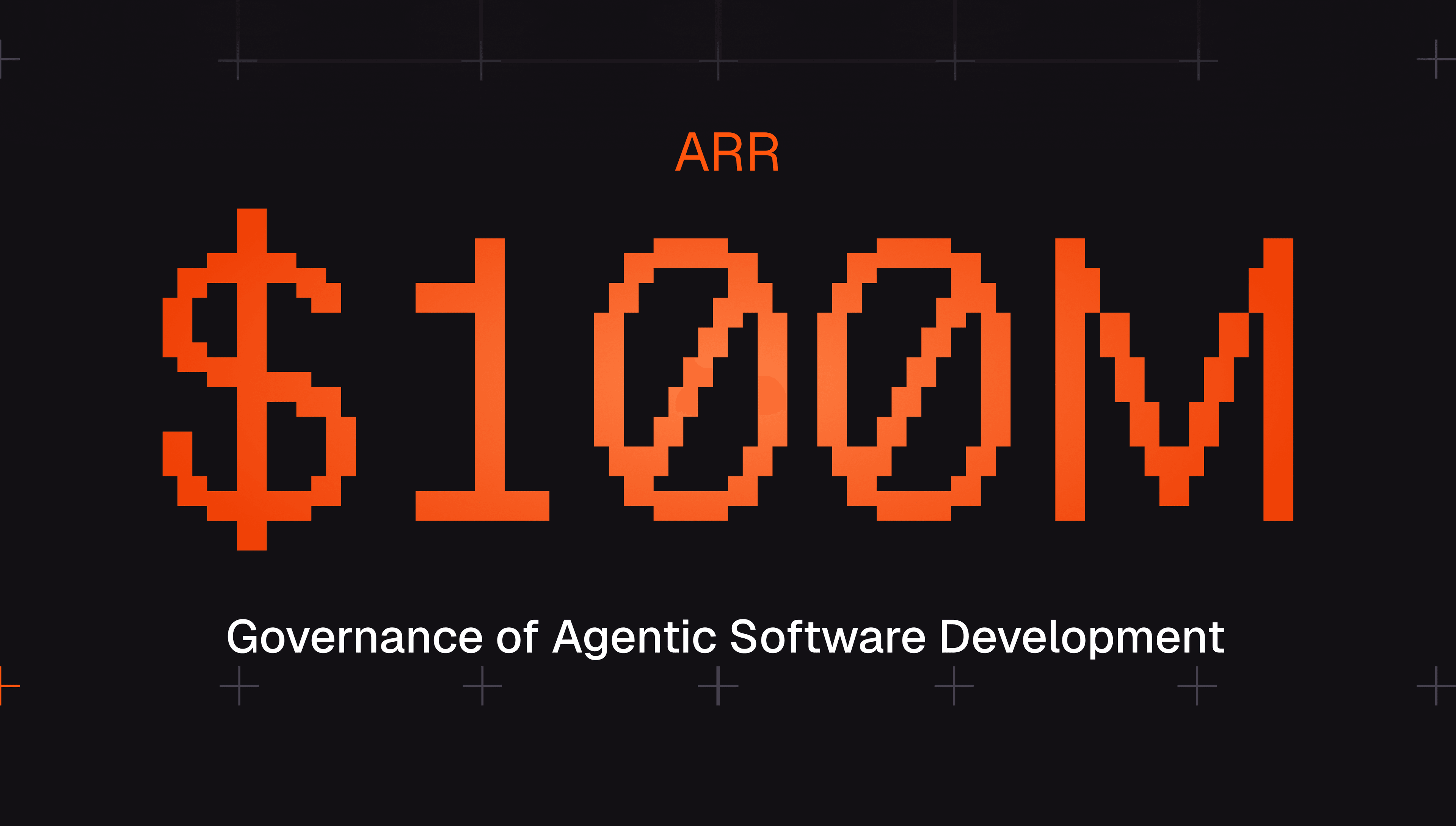
Today we’re sharing a milestone that shows how far the AI disruption has spread, and how quickly our category is growing: CodeRabbit has grown from $10 million to $100 million in annual recurring revenue in just over a year.
More than 20,000 customers and 400,000 monthly active users now use CodeRabbit to review, triage, explain, and secure their codebases, with the average team shipping software at twice the rate it did before CodeRabbit. Engineering teams put more than 3 million pull requests through CodeRabbit every week. To date, CodeRabbit has surfaced more than 100 million issues, bugs, and vulnerabilities to be fixed before code reaches production.
Code generation got cheap. Judgment didn't.
Coding agents have fundamentally changed the shape of pull requests. There are more of them: among a cohort of tracked users, weekly PRs rose 128% year over year. PRs are also larger and harder to read, and agent-written changes are often no longer human-readable at all. But engineers are still being asked to validate every PR and do so at the same speed that agents create them.
Many teams are responding by skipping the reading. In a June 2026 New Relic survey, 62% of tech leaders said their teams often ship AI-generated code to production without line-by-line review.
Giving up quality for speed is a trade-off we refuse to accept. Engineering teams can only ship software as fast as they can trust it. If agents produce changes faster than people can judge them, judgment has to scale too.
The engineers of the next decade won't spend their days writing code. They'll be architects, setting intent and standards and judging what ships. At agent scale, no human can judge every change line by line, so you need an AI layer that validates each PR against your standards as fast as agents produce them. And the AI layer can’t be the agent that wrote the code.
Hunting for bugs and known bad patterns is now only a small part of validating a PR. When agents write most of your code, the harder questions are whether it is fit for purpose and fit for your company. Does it follow your standards? Is it architecturally sound? Is it duplicative or bloated? And are you feeding what you learn from each release back into what you expect of the agents?
Trusting code your engineers didn’t write
CodeRabbit is used by fast-growing AI-native companies and established, regulated institutions alike. Dialpad sells an AI-powered customer communications platform to more than 50,000 companies. Questrade Financial Group is a Canadian financial institution with more than $100 billion CAD in assets under administration. Both arrived at the same conclusion about trusting AI-written code.
We build AI for a living and our engineers build with it every day, so we know generating code was never the hard part. Trusting it is. We aren’t going to let the model that wrote the code decide whether it is fit to ship. CodeRabbit gives every change an independent review, tells us what it does and how risky it is, and keeps watching after it merges. Our engineers spend their time on the decisions that need a person, and we ship more with greater confidence.
— Brian Peterson, co-founder and CTO, Dialpad
We hold every change to the same standard, however it was written. CodeRabbit gives us a consistent, independent review before anything ships, so our teams can use AI in the way that works best for them.
— David Wieler, Chief AI Officer, Questrade Financial Group
Security is part of code quality now
The definition of quality expanded this year to include security. Attackers can now point agents at code they have never seen to find and exploit vulnerabilities cheaply and at massive scale. The answer is to turn the same kind of agents on your own code and find those vulnerabilities first.
In October, we joined the OpenAI Daybreak Defense Network, which embeds frontier models directly in software security workflows, and brought OpenAI's GPT Cyber models into CodeRabbit Secure. We also committed $1 million to fund free Deep Scans for any organization or open-source project. In the program's first ten days, more than 2,700 organizations ran over 13,000 scans. Those scans surfaced more than 43,000 critical or high-severity findings, and one in three scanned repositories had at least one. Nearly 10,000 of those vulnerabilities have already been fixed.
Independent review, wherever the agents are built
The companies building frontier coding agents now offer CodeRabbit on their platforms. In May, CodeRabbit became available on Anthropic’s Claude Marketplace, and in September we joined the OpenAI Marketplace as an anchor partner; both let customers apply existing spend commitments toward CodeRabbit on a single invoice. In October, we became an authorized partner in the SpaceX Super Intelligence Partner Network and launched in the Grok Build Plugin Marketplace. And this week, CodeRabbit arrived in the Google Antigravity Plugin Marketplace, where Antigravity writes the code, CodeRabbit reviews it, and Antigravity fixes the findings in the same agentic loop. Each puts CodeRabbit next to the agents those labs ship as the independent layer that validates what the agents produce.
That layer has to stay independent of any single model, too. Our review pipeline is model-agnostic, and in January we added NVIDIA's Nemotron family of open models to it alongside the frontier models already there.
A milestone on a longer mission
Revenue is a lagging indicator. What $100 million represents is progress on a larger mission of helping every engineering team in the world ship software as fast as they can imagine. The milestone is a reflection of the decision made by thousands of engineering teams this year to validate code as fast as they generate it, and to trust CodeRabbit to make that possible.
If your team is ready to ship better software, faster, try CodeRabbit on your next pull request. It takes two clicks to set up, and is free to get started.