CodeRabbit logoCodeRabbit logo
AgentEnterpriseCustomersPricingBlog
Resources
  • Docs
  • Trust Center
  • Contact Us
  • FAQ
  • Reports & Guides
Log InGet a free trial
CodeRabbit logoCodeRabbit logo

Products

AgentPull Request ReviewsIDE ReviewsCLI ReviewsPlanOSS

Navigation

About UsFeaturesFAQSystem StatusCareersDPAStartup ProgramVulnerability Disclosure

Resources

BlogDocsChangelogCase StudiesTrust CenterBrand GuidelinesReports & Guides

Contact

SupportSalesPricingPartnerships

By signing up you agree to our Terms of Use and authorize CodeRabbit to provide occasional updates about products and solutions. You understand that you can opt out at any time and that your data will be handled in accordance with CodeRabbit Privacy Policy

discord iconx iconlinkedin iconrss icon
footer-logo shape
Terms of Service Privacy Policy

CodeRabbit, Inc. © 2026

CodeRabbit logoCodeRabbit logo

Products

AgentPull Request ReviewsIDE ReviewsCLI ReviewsPlanOSS

Navigation

About UsFeaturesFAQSystem StatusCareersDPAStartup ProgramVulnerability Disclosure

Resources

BlogDocsChangelogCase StudiesTrust CenterBrand GuidelinesReports & Guides

Contact

SupportSalesPricingPartnerships

By signing up you agree to our Terms of Use and authorize CodeRabbit to provide occasional updates about products and solutions. You understand that you can opt out at any time and that your data will be handled in accordance with CodeRabbit Privacy Policy

discord iconx iconlinkedin iconrss icon

Why your internal AI code review tool will cost more than you think

by
David Loker

David Loker

June 03, 2026

7 min read

June 03, 2026

7 min read

  • The math that gets underestimated
  • What the internal tools actually run into
  • So, should you build or should you buy?
  • The case for buying
Back to blog
Cover image

Share

https://victorious-bubble-f69a016683.media.strapiapp.com/Reddit_feecae8a6d.pnghttps://victorious-bubble-f69a016683.media.strapiapp.com/X_721afca608.pnghttps://victorious-bubble-f69a016683.media.strapiapp.com/Linked_In_a3d8c65f20.png

Cut code review time & bugs by 50%

Most installed AI app on GitHub and GitLab

Free 14-day trial

Get Started

Catch the latest, right in your inbox.

Add us your feed.RSS feed icon
newsletter decoration

Catch the latest, right in your inbox.

Add us your feed.RSS feed icon

Keep reading

You’re addicted to AI code generation. Now what?

You’re addicted to AI code generation. Now what?

Developers distrust AI coding tools just enough to double-check the output, yet rely on them too much to turn them off. Here's what that dependency is actually costing engineering teams, and how to build review systems that keep up with it.

You can build an AI code reviewer. But you probably can’t maintain it

You can build an AI code reviewer. But you probably can’t maintain it

Most homegrown AI reviewers work for one repo. The hard part is holding a consistent quality bar across hundreds of engineers and a shifting AI tooling landscape.

Opus 4.8 benchmark results for AI code review and code generation

Opus 4.8 benchmark results for AI code review and code generation

Opus 4.8 is the best model we have used for long-horizon agentic coding and code generation, and it holds its own on code review out of the box.

Get
Started in
2 clicks.

No credit card needed

Your browser does not support the video.
Install in VS Code
Your browser does not support the video.

When engineering teams start evaluating AI code review, the build option gets serious consideration fast, and having spent years building ML infrastructure at Netflix and Amazon, co-founding a generative AI company, and now serving as VP of AI at CodeRabbit, I understand why.

The models are accessible, the APIs are straightforward, and with agentic coding tools like Claude and Codex now doing a meaningful share of the implementation work, a strong engineering team can get a working prototype out the door faster than ever before. The barrier to building has genuinely come down, and that's worth acknowledging honestly before making the case against it.

But a working prototype isn't really what's being evaluated. What engineering teams are actually deciding is whether they can own this internal tool for two years. And that's where the math changes. What shows up in that first sprint is maybe ten percent of what it actually takes to run AI code review well over a longer period of time.

From my own personal experience, and with speaking with customers who tried to build their own code review tool internally, the gap between a working demo and a solution your security team, your compliance team, and engineers across dozens of repositories can actually rely on is where the real cost lives.

This piece works through what that investment looks like in practice, with a breakdown of the maintenance requirements that tend to get underestimated at the outset and cost comparisons across three company sizes, so that the decision is grounded in something more honest than a back-of-napkin estimate of what it takes to ship a prototype.

The math that gets underestimated

Attio documented what it actually took to build and run their own AI code review tooling. Their experience is useful because they were honest about it: the early prototype was tractable, but the operational surface area kept growing.

That pattern is consistent across the organizations we have spoken with.

When you model the real cost of building internally, not just the initial build sprint but the maintenance team, model evaluation cycles, infrastructure, security reviews, and internal support, the numbers look very different from the back-of-envelope calculation that usually kicks off the project.

Our cost benchmarks are derived from Attio's publicly documented implementation, scaled for org size based on what we consistently see in practice. For a mid-enterprise org of 700 to 1,500 engineers, a realistic build team is 4 to 8 engineers spanning backend, infrastructure, and ML/prompt engineering roles, typically with one PM, over a 3 to 6 month build window. For large enterprise organizations at 2,500 to 4,000 engineers, that scales to 6 to 12 engineers.

All FTE costs assume $180k to $250k fully loaded (base salary, benefits, equity, and overhead), which is consistent with industry benchmarks for senior engineering roles in this space.

At those numbers, the annualized cost of a maintained internal tool for a mid-enterprise org runs somewhere between $650,000 and $2 million. That range accounts for the ongoing maintenance team, initial build costs amortized over three years, model and API costs that tend to run $100,000 to $500,000 at that scale, and the infrastructure and operational overhead that accumulates as the tool becomes load-bearing across the organization.

For enterprise organizations at 2,500 to 4,000 engineers, the spread is wider. Building internally at that scale requires what amounts to a full product team: six to twelve engineers, a PM, compliance and security layers, and model costs that can exceed $2 million annually.

Total cost: $2.35 million to $7.5 million per year, before accounting for the opportunity cost of the engineering teams building and maintaining it over time.

What the internal tools actually run into

The cost model alone does not tell the whole story. The harder problem is that internal AI code review tools tend to follow the same failure patterns regardless of how good the initial implementation is.

  1. The first is cost overrun: As the initial build often lands on budget. What teams underestimate is that maintenance costs grow as the tool sees broader adoption, model costs accumulate, and reliability expectations rise across the org. By year two, the internal tool frequently costs more to run than a purpose-built external solution would have from day one.

  2. The second is low adoption: From our conversations with engineering teams, there are two main reasons for low adoption of internally built AI code review tools. The first is that they produce low quality reviews that lack context on the codebase and dependencies. The second is lack of integration into existing workflows, like with the developer's choice of agent. When integration is shallow, human reviewers continue carrying the load as the tool runs in the background without changing much.

  3. The third is outright sunset: PR volume accelerates, often driven by AI coding agents, faster than internal tooling can keep up with. Signal-to-noise deteriorates. Developers stop trusting the output. The project gets shut down and teams return to fully manual review at a volume that senior engineers cannot absorb.

These are not edge cases, they are the three most common outcomes we see from organizations that have gone through this cycle.

So, should you build or should you buy?

Writer, an AI-native company had the technical capability to build an AI code review tool.

Their engineering team evaluated the option and concluded the resource cost was not justified. The time it would take to build something production-grade would pull engineers away from the core product. The ongoing maintenance would do the same thing indefinitely.

They chose CodeRabbit, and it now runs across more than 37 repositories, with review cycles 30% faster. The engineering team that would have been building and maintaining an internal tool is building Writer instead.

A large global internet company built their own code review tool in-house. For a while it worked, then, they needed to scale from a few hundred developers to close to 3,000. Their homegrown tool couldn’t get there.

Beyond the scaling problem, keeping the tool running was costing them close to $1M a year in maintenance alone with engineering hours and resources going toward an internal tool instead of the product.

They chose CodeRabbit and decided to leave behind their homegrown tool alongside the maintenance burden that came with it.

That is the actual question for most engineering leaders: what is this team's core competency?

If it is the product you are selling, an internal AI code review platform is probably not the best use of the engineers you have. The maintenance burden, covering scale, upgrades, security, on-call, noise tuning, and knowledge continuity as teams change, is real and it grows.

The case for buying

If you are seriously evaluating whether to build internally, run the numbers on your specific org size before scoping the project. Token costs, engineering headcount, PR volume, and infrastructure requirements all affect the calculation differently depending on where you are.

The gap between build and buy tends to be larger than teams expect at the start of the evaluation, and it widens as the org grows.

That’s because production-grade AI code review is more than a single LLM prompt reviewing a diff. CodeRabbit has spent the last three years refining our context engine across millions of pull requests and more than 15,000 engineering teams. That accumulated domain expertise, knowing which context matters for which kind of change, is the difference between a system that summarizes diffs and one that finds the issues that could derail what you intended to ship.

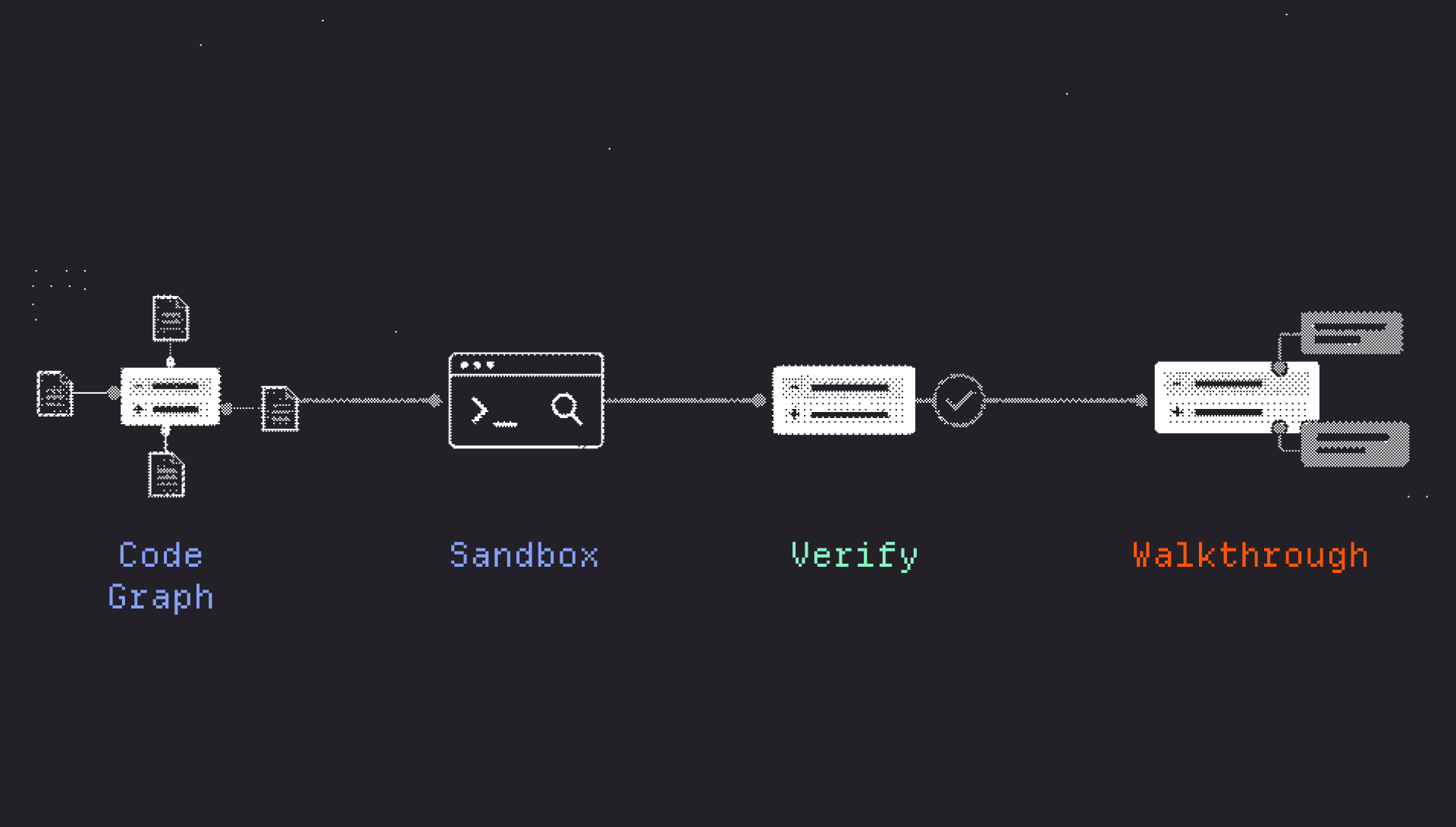
CodeRabbit combines sandboxed repository analysis, specialized AI agents, autonomous code exploration, persistent memory, and integrates with 40+ linters and security scanners to understand your codebase at a much deeper level.

We built a calculator that lets you model your specific context, covering team size, PR volume, and fully-loaded engineer cost. It is available in our full Build vs. Buy guide with detailed cost breakdowns for mid-enterprise, and enterprise scenarios.