Code review has been broken for 18 years. We built the fix.
If you have been reviewing code for more than a few years, you know a quiet truth that nobody has bothered to fix. Code Review has essentially been the same since GitHub was launched in 2008. Files, alphabetical order, scroll to the bottom. Rinse and repeat 1,000 times a year.
Meanwhile, the author who wrote the pull request understands it as a story, as a new data shape, the logic that consumes it, the call sites, and the tests. That story exists in their head but nowhere in the review interface. The reviewer has to reconstruct it from scratch, file by alphabetical file, before they can even begin to evaluate correctness.
That cognitive overhead is why big PRs sit for days. It is why senior engineers often rubber-stamp anything over 500 lines. It is why architectural feedback is rare and nit-picks are abundant. The tool has been shaping the behavior, and not in a good direction.
Today, CodeRabbit is shipping Change Stack, a fundamentally different way of doing code review.
What Change Stack does
Change Stack takes any pull request and reorganizes it from a flat file list into a guided walkthrough. Instead of presenting files alphabetically, it groups related work into a small number of independent change cohorts. Each cohort is broken into ordered layers that reflect the natural reading order of the change. It is the way a thoughtful senior engineer would choose to walk someone through it.And every layer anchors to specific line ranges in the actual diff, and carries its own AI-generated summary. When the structure of a layer warrants it, such as a new API contract, a state transition, or a cross-service call sequence, Change Stack generates a diagram alongside the diff. Change Stack renders the visual that best captures what the code is actually doing, whether that is a sequence diagram, a state machine, or an entity-relationship diagram. Not every layer gets one, just the ones for which a visual aid would make things easier to understand.
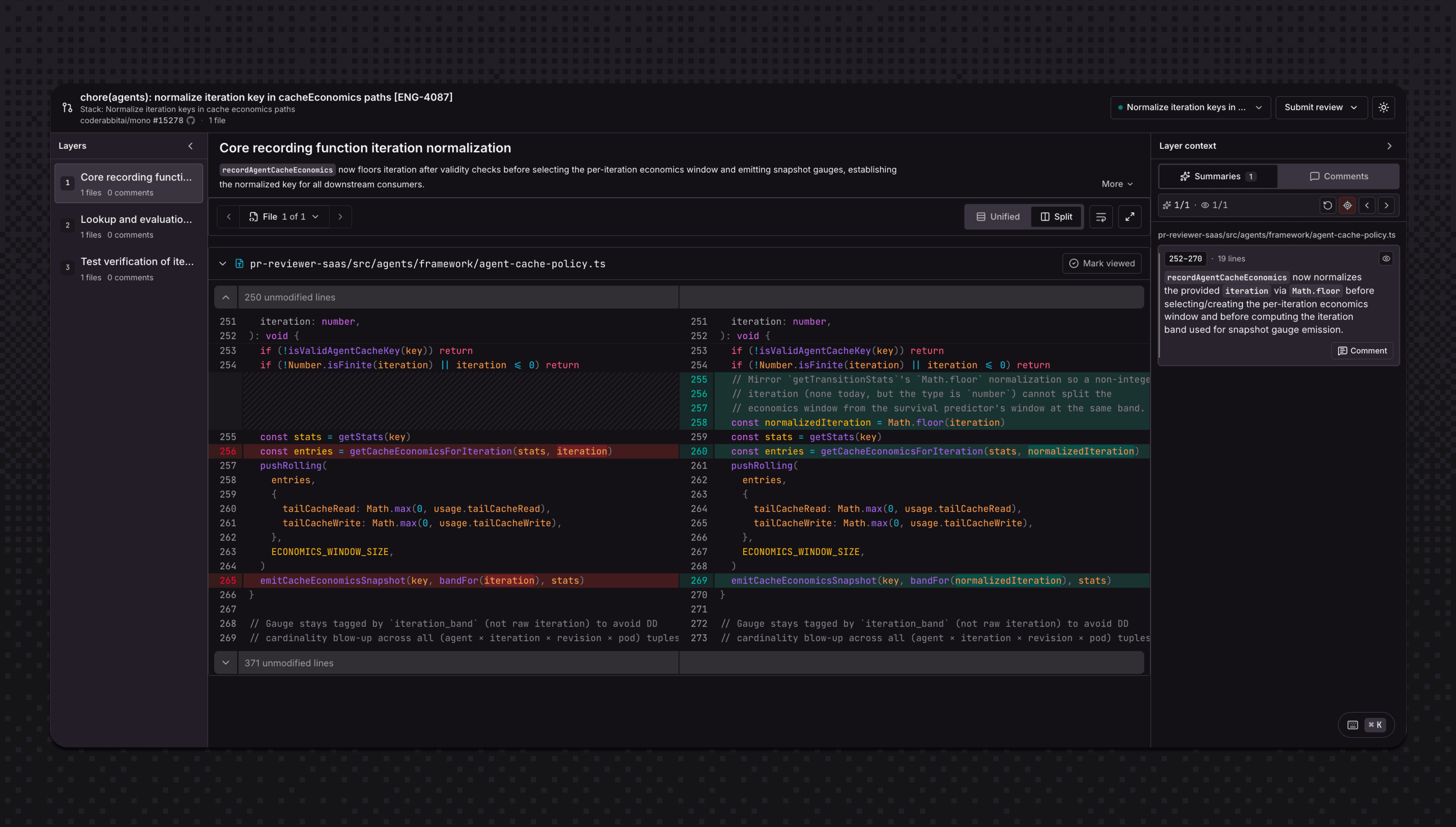
The three-panel layout puts cohort and layer navigation on the left, the diff in the center, and per-range context on the right. Keyboard navigation ('J' to advance, 'K' to go back, 'Z' for focus mode) keeps your hands off the mouse. Reviewers mark files as viewed, drop inline comments against specific ranges, accumulate a draft review, and submit a real GitHub review, all without switching tabs.
Critically, reviews post back to GitHub natively. It is an upgrade to the review interface that still lands comments and approvals exactly where your team expects them, without disrupting your existing workflow.
Why you should care
If you are a senior developer or a tech lead whose team is shipping multiple, complex PRs in any given week, then you know that the de facto bottleneck on the team’s merge velocity is providing fast review without sacrificing quality. Change Stack directly addresses that constraint, by breaking down the code change into easy-to-review chunks, arranged in a logical manner.
Change Stack also helps with cross-team reviews, those where you get pulled in because you had owned a touched file or a security-sensitive path. Prior to Change Stack, on a PR like this, you’d typically spend your first 20 minutes reverse engineering what the PR is even about before you can even consider next steps. Change Stack, however, makes that orientation immediate. For example, a Change Stack sequence diagram showing the new call path, or a state machine illustrating the updated lifecycle reduces that 20 minutes of reverse engineering to 30 seconds.
Why we think this approach is better
The current generation of AI code review tools address the review bottleneck by layering a smarter comment bot on top of the existing GitHub interface. But, that approach backfires. More comments on an already noisy PR thread increase the cognitive load on the reviewer, who now has to parse code changes, human feedback, and AI-generated commentary all at once. The problem is worse for large, unstructured diffs, and this problem has compounded sharply as AI-generated code volume has surged over the past year.
Change Stack, however, is a completely different angle on how the review process works. It assists the reviewer to reduce this cognitive load by providing a walkthrough of how the PR author would have crafted the diff, all while augmenting that with visuals.
Built for how reviews actually work
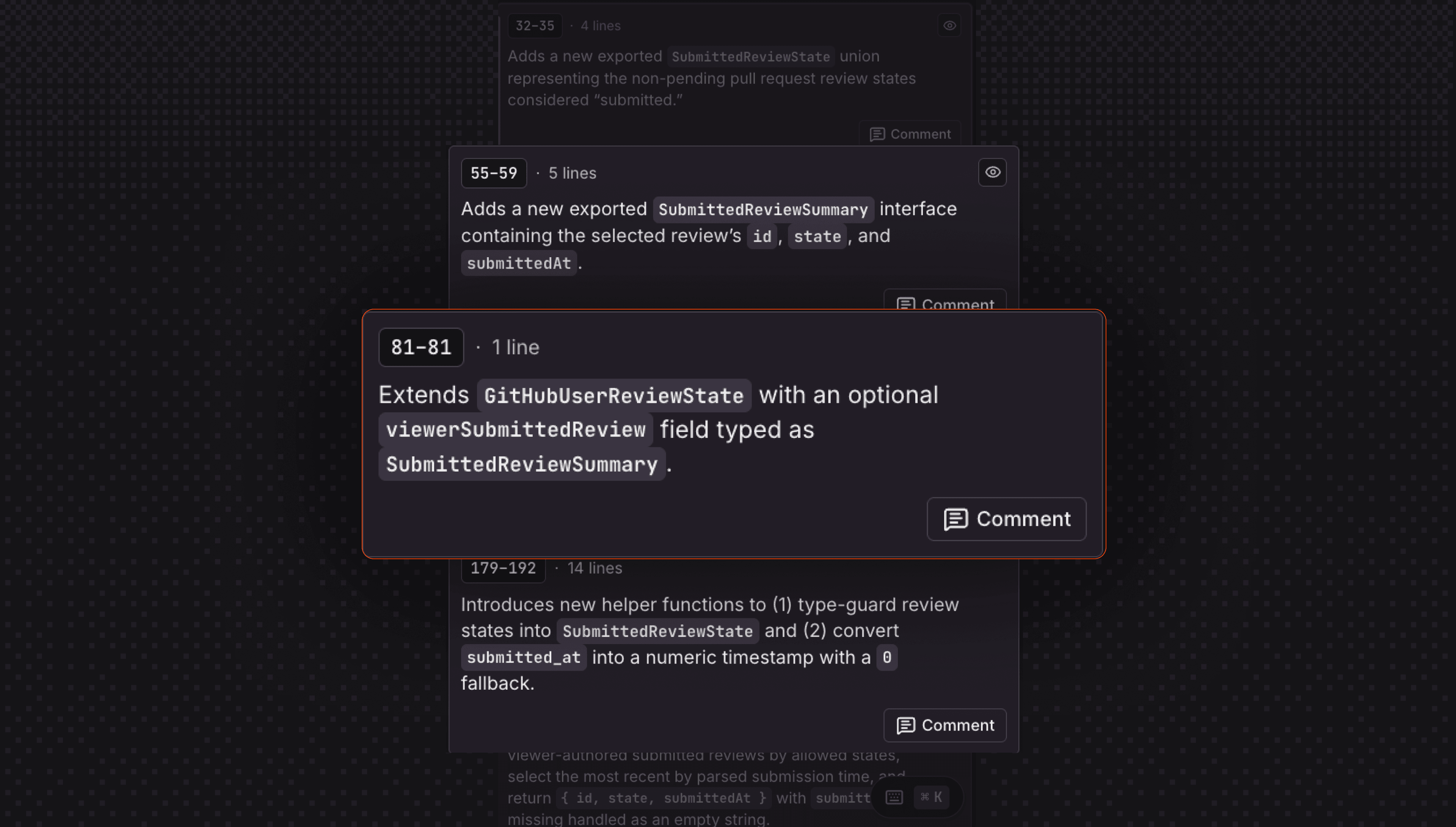
- Reviewable layers: Change Stack breaks a PR into functional layers, so reviewers can move through the change by intent instead of the raw file order.
- Diagrams (when they help): Layers can include Mermaid diagrams for real flows, state changes, data relationships, or schema changes. Simple layers stay text-only.
- Layer-scoped diffs: Each layer shows the code ranges that belong to it, with surrounding context, so reviewers stay focused on the part of the PR being explained.
- Active summary sync: As reviewers scroll through a layer, the right rail of the user interface highlights the summary that matches the code currently in view.
- Snapshot history: Change Stack retains a snapshot for a PR, and reviewers can switch between them from a snapshot selector.
- Out-of-date warnings: If the PR has moved beyond the snapshot being viewed, Change Stack shows that the view is stale and identifies the commit it was generated from.
- GitHub-native reviewing: Comments and final review actions (approvals, change requests) sync with the GitHub surface.
- Public read-only sharing: Public PR walkthroughs can be opened without signing in. Commenting still requires GitHub authentication.
- Reviewer-owned sign-in: The GitHub sign-in flow preserves the exact Change Stack URL, including the selected layer or snapshot, and posts review activity as the reviewer.
- Opt-in workflow: Change Stack opens from a CodeRabbit link and leaves the normal GitHub PR workflow intact for anyone who does not use it.
What comes next
Change Stack is the beginning of a more guided review experience. Code review should show more than what changed. It should help teams understand why it changed, where to focus, and how each decision fits into the larger system. We are building toward agentic change management, with reviews that feel less like parsing diffs and more like following the story of the software as it evolves.
The diff has not changed in 18 years. We think it is time.
Change Stack is available for free for a limited time to all users. Try it on the next large PR that lands in your queue. The “Review Change Stack” button is in CodeRabbit's PR summary comment.