
Imagine your team got Claude licenses three weeks ago and pull request (PR) volume jumped. The bottleneck moved from writing code to reading it, as AI can help teams create PRs faster than human review queues can absorb.
Agentic code review uses repository context to evaluate intent and cross-file impact across the codebase, which makes it the natural next step once authoring speeds up. Rollout lives or dies on mechanics. How do we slot an AI agent into an existing PR flow without breaking branch protection or eroding reviewer trust by week three? The agent has to fit into the PR path, and the team has to measure whether it actually improves review.
For examples of where that context matters, see how CodeRabbit handles massive codebase reviews and why teams pair AI code generators with AI code reviewers.
Why code review is the new bottleneck for AI-assisted teams
When verification becomes the constraint, teams face a tradeoff. Close review turns human oversight into the bottleneck; loose review turns quality into the risk.
The numbers behind the review squeeze
Review pressure is now measurable in PR volume, AI-code cleanup, and issue density. Platform-wide merged pull requests rose from a 2024 monthly average of 35M to 43.2M in 2025. AI-generated code can also feel harder to review than the human-written kind.
In Stack Overflow's 2025 Developer Survey, 66% of developers say they spend more time fixing "almost-right" AI-generated code, and trust in AI accuracy fell to 29% in 2025, down from around 40% in prior years. The pressure also shows up inside the code. AI-co-authored PRs averaged 10.83 issues per PR vs 6.45 for human-only PRs in the State of AI research.
Fix review before you add more coding agents
Adding coding agents before fixing review compounds the queue. AI authoring moved the bottleneck to review, so teams need a review system that can absorb the output without turning every senior engineer into a permanent gatekeeper.
Taskrabbit made that sequence explicit. The team fixed review before adopting AI coding agents and reduced time to merge by 25%, from 10 days to 7, while running 300 PRs/week through CodeRabbit.
What agentic code review catches that linters & SAST tools miss
Linters and SAST tools already run in your pipeline, so the first question is what an agent adds on top.
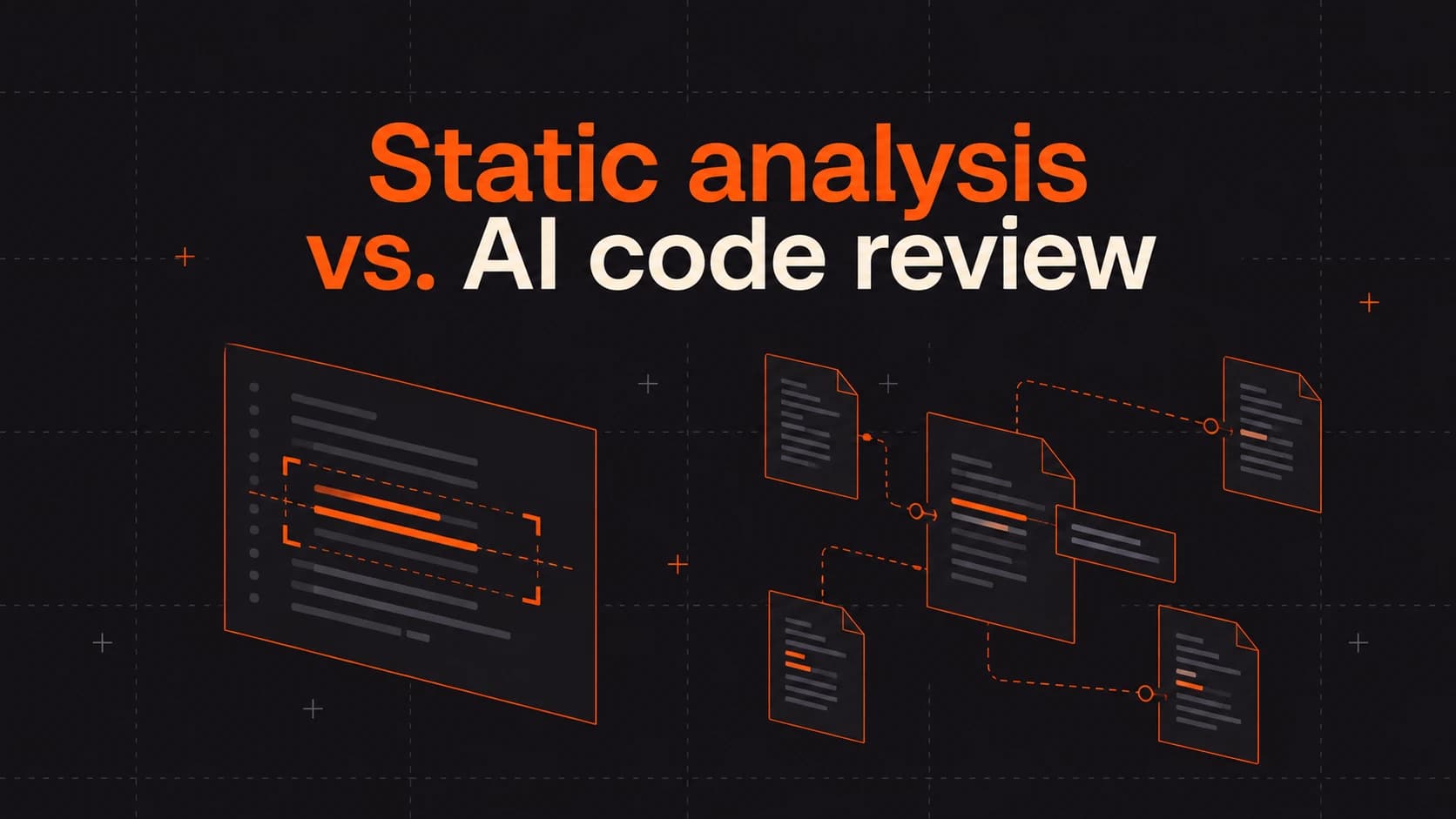
Static analysis catches rules and patterns. Programmer intention requires more context. That matters when the problem is workflow logic, where a missing authorization check, an edge-case branch, or the interaction between a caller and a callee several files away can decide whether the change is safe. In AI-assisted review, many important judgments depend on code meaning more than syntax.
Where the agent gets its context
A stronger AI review usually benefits from more surrounding context than the diff alone. CodeRabbit reviews across PR, IDE, CLI, and Slack, so first-pass feedback lands where the workflow already lives. Codegraph, linked tickets, prior PRs, and team decisions give the agent context for runtime errors, null pointer exceptions, race conditions, and logic flaws before deployment, extending review beyond changed-line checks.
Where agentic review stops
Agentic review has its own bounds, and stating them plainly builds trust. The analysis depends on the context available to the agent in the review session. The review session may exclude some dependencies and generated artifacts. An AI agent gives you a first pass. Human reviewers keep merge authority.
How to add an AI agent to branch protection without breaking your merge gate
An AI agent slots into your existing PR flow in one of two places, and picking the right one at rollout matters. The two patterns map cleanly onto GitHub and GitLab branch-protection mechanics.
Non-blocking review comments
GitHub's pull request review model supports a Comment status, described in the docs as "Share feedback without approving or requesting changes," which does not count toward required approvals. An AI agent posting only Comment-type reviews adds findings to the PR without touching the merge gate.
Blocking via a required status check
GitHub branch protection requires specified status checks to pass before merge. Teams can wire an AI agent into the gate by posting a commit status or check result and listing that check as required in the branch protection rule.
On GitLab, the equivalent control runs through Code Owner approval on protected branches and required approval rules.
Stage the rollout from optional to required
Start by deploying the agent so it posts comments and a status check, but do not list it as required initially. Once your false-positive rate stabilizes, elevate the check to required. This keeps the agent visible while human CODEOWNERS approvals remain the gate. A skipped check reports Success and won't block merge, so a non-required check costs you nothing while you validate.
A CodeReviewBot study found that PR authors addressed 73.8% of automated comments, and the study recorded 88 commits after the automated reviews but before human review began. Automated feedback reached authors before a person opened the PR. Agentic reviews can follow the same sequence.
Review new PRs automatically, update feedback as commits land, and reserve Pre-Merge Checks for teams that want a hard gate on linked-issue requirements.
What human reviewers do that an AI agent can't
Use the agent to clear routine findings before a person opens the diff, then spend reviewer attention on context, ownership, and risk. That framing tracks what decades of research say human review is actually for.
What the research says review is for
Human review earns its time when it transfers context and judgment. Bacchelli & Bird's Microsoft study found that while finding defects remains the stated motivation for review, "reviews are less about defects than expected" and instead deliver knowledge transfer and team awareness, with "context and change understanding" as the core of any review. Those parts of review depend on shared context beyond the diff. Tooling can move correctness checks into static analysis and automated testing, but it does not erase inspection. Sadowski et al.'s Google case study says "tooling might never completely obviate the value for human-based inspection of code."
The same principle appears in human in the loop review flows, which Microsoft Engineering describes as a design principle for AI-powered code review. Agents surface candidate issues; reviewers make the call.
Accountability stays with the human
The accountability point is the one automation can't absorb. The developer still ships. The agent makes the diff cleaner before the human reviewer arrives, so that human attention goes to the design questions only a person can answer.
Which metrics prove agentic code review is working
Start with review latency
Pick three numbers before rollout and watch them for a month. Review latency moves first, so start there. LinearB defines pickup time as the gap between PR creation and the start of code review, and its pickup benchmarks from roughly 2,000 teams put elite pickup time under 7 hours against a recommended target of one hour or less. An always-on first reviewer attacks this number directly, because the first substantive feedback now lands in minutes.
Change failure rate & defect escape rate
Track change failure rate and defect escape rate next, so faster review does not hide production bugs. DORA (DevOps Research and Assessment) tracks change failure rate, the ratio of deployments that require immediate intervention, and Jellyfish lists defect escape rate as a quality diagnostic. Faster review only matters if the bugs that reach production do not climb with it.
How reviewer time gets reallocated
The third number is reviewer-time reallocation, and you may need to instrument it yourself by tracking comment-type distribution over time.
Tag comments for nits, correctness, security, tests, and design, then watch whether human review moves toward the last three. There is precedent for treating review timing as a productivity signal.
The SPACE framework, a model for measuring developer productivity, places code review timing under its Efficiency and flow dimension. And the cost of slow review is real. LinearB found that small PRs waiting days for review drew a rubber-stamp, a "Looks good to me" comment, 80% of the time.
freee's engineering team saved 32.8 weeks of reviewer time over six months as the rollout expanded to 570 seats and 285 repos.
How to evaluate an agentic code reviewer before rollout
Before we wire an AI agent into the gate, validate the false-positive rate, then confirm the team can tune sensitivity before irrelevant comments teach people to ignore the agent. Get this wrong and the agent loses its audience.
Set the false-positive bar at 90%
Google's Tricorder platform sets the number for code-review-time analysis with a false-positive ceiling: "Developers should feel the check is pointing out an actual issue at least 90% of the time." Google's account treats developer confidence as the constraint.
Trust can erode quickly. Once engineers learn that the agent's feedback is often wrong or trivial, they may stop investigating carefully and start pattern-matching it away. This makes the pre-rollout window the one that matters, before false positives have a chance to train the wrong habit.
Score finding precision by severity
One practical validation protocol is to sample a representative set of findings over a sprint, have senior engineers classify each as true positive, false positive, or debatable, and track precision by severity level. Security findings get more latitude. As Software Engineering at Google notes, reviewers will tolerate a higher false-positive rate for analyses that identify critical security problems.
Tune sensitivity to keep the signal high
Configurable signal sensitivity addresses false positives. Path-based instructions apply custom rules only to the paths you choose, so you can turn review volume up on high-risk directories and down elsewhere. AST-grep rules add structural pattern matching for checks that depend on code shape rather than location. CodeRabbit Learnings store design choices from PR comments and apply them to future reviews, so the agent's signal improves instead of drifting.
AI writes the code faster than ever, and the State of AI report points to the same mitigation pattern. Add context up front, then verify independently.
David Loker of CodeRabbit put it plainly. "AI accelerates output, but it also amplifies certain categories of mistakes." A context-rich AI agent, slotted in as the first reviewer with sensitivity tuned and humans holding the gate, is how we ship at agentic speed without letting review turn into the new bottleneck. Every line still earns its merge.
Cut code review time & bugs by 50%. Most installed AI app on GitHub and GitLab. Free 14-day trial. Get Started.