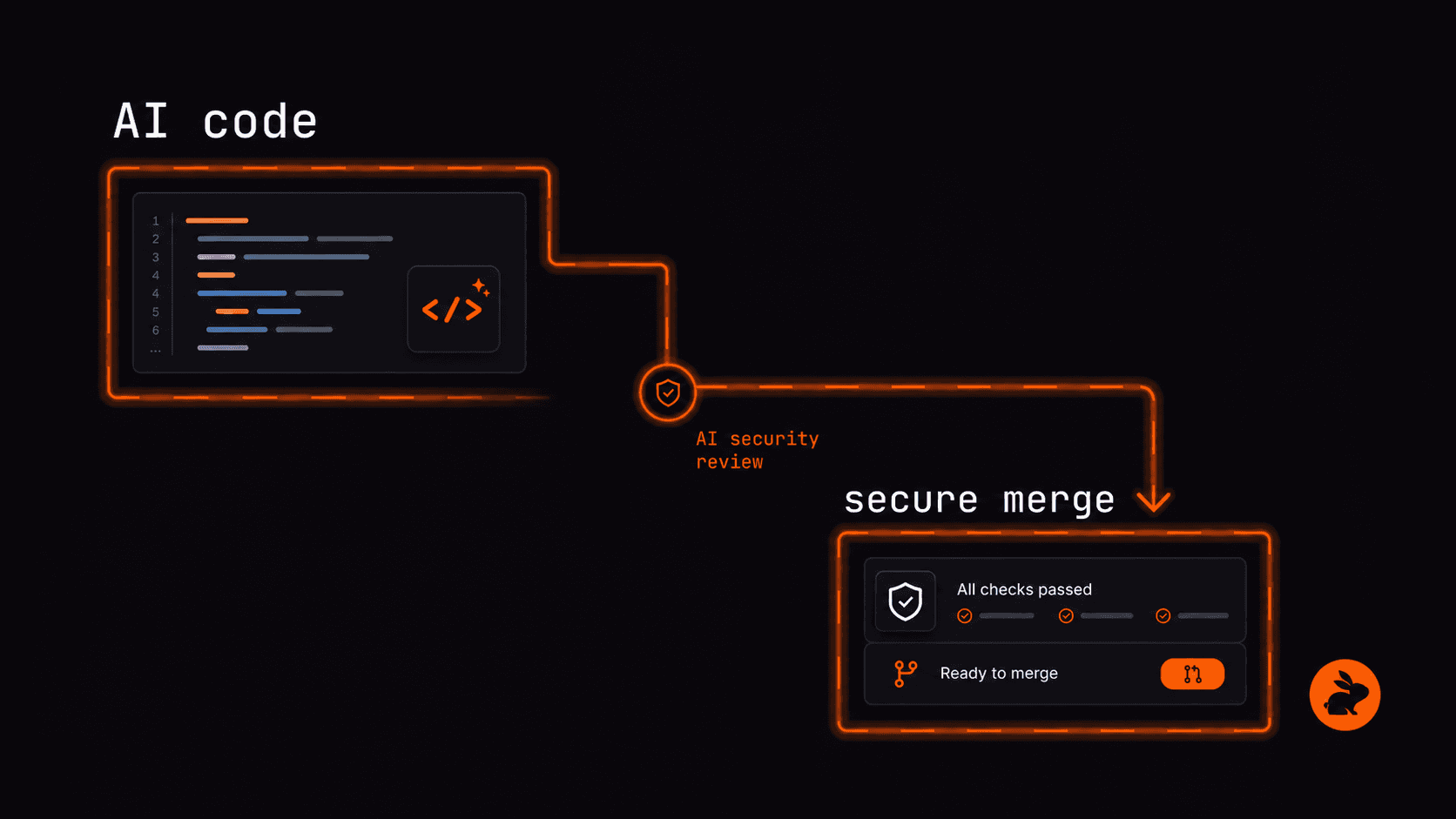

AI coding agents are now common enough that agent-written code can move toward production without a control point you can name. AI governance for coding agents means putting a verification gate in the path of agent-authored changes, then recording what the gate checked and who approved the merge.
Developers can ship more code than traditional review can absorb. The gate has to sit where every production-bound change already passes. For many teams, that point is the pull request merge gate, backed by policy configuration and an audit record.
Why coding agents break traditional governance
Agent sprawl is the uncontrolled proliferation of coding agents and their tooling across an engineering org, where unreviewed AI-generated changes can reach production because no central control point catches them. In practice, developers may switch among tools, mixing usage between Cursor, Codex, Claude Code, and others. That creates security risk from agent access to sensitive data, cost pressure as agent spend grows, and a visibility gap where leaders cannot see what teams are adopting.
Adoption is outpacing trust
Among more than 49,000 developers in Stack Overflow's 2025 Developer Survey, 80% now use AI coding tools. At the same time, developer trust in AI accuracy fell to 29% from 40% in prior years. Agent use is growing faster than the review process around it. It is also a shadow-IT problem, because agents and integrations can stay invisible and unreviewed until a security or audit event forces the inventory question.
Why agent sprawl defeats manual review
Limited inventory visibility is one failure mode, but the path to a production incident is simpler. AI-generated code can ship without human review, and when it does, hardcoded secrets, security vulnerabilities, and deprecated libraries slip in with it. The review layer has to follow that change from wherever work starts back to the team's merge process, because the merge process is where the org can still catch it.
Review load is the control problem. CodeRabbit's AI vs Human report reviewed 470 PRs and found AI-authored changes produced 10.83 issues per PR against 6.45 for human-only PRs, about 1.7x more. The gap widens to 26 versus 12.3 at the 90th percentile, and manual review becomes structurally difficult at that volume. As InfoQ reported, Agoda engineer Leonardo Stern put it sharply: the white box model breaks when agents produce thousands of lines per hour.
Required PR review keeps agent-authored issues in front of reviewers while context is still attached to the diff.
Where to enforce AI governance: the pull request merge gate
Governance gets enforced at the pull request merge gate. It is the one organization-wide control point in the software development lifecycle that every production-bound change has to pass, which lets teams check changes before they enter protected branches. Enforcement in the IDE stays voluntary, and enforcement after deploy starts only once remediation is already underway.
Taskrabbit proved the pattern before it adopted coding agents. The marketplace cut average PR cycle time by 25%, from 10 days to 7, while running 300 PRs/week through CodeRabbit, increasing review throughput before agent output could expand the queue.
Because the gate sits on the change itself, it governs agent output regardless of which agents a team has adopted. Once the merge gate is in place, knowing exactly which agents are in use matters less than it did, because nothing reaches production without passing the same check.
Make the merge gate mandatory with branch protection
In the DevOps Research and Assessment (DORA) model, teams create a branch in version control and merge it after approval. That process minimizes the friction of letting other teams propose changes while preventing unauthorized changes and enforcing security controls such as segregation of duties. Branch protection makes the gate mandatory. GitHub's protected branch rules can block merges until reviewers approve the pull request.
PR enforcement turns review into a required system step. The system checks the change before it reaches production and leaves evidence while the work is still fresh. Reviews then depend less on individual discipline or social pressure, because the system requires them.
Add AI code review at the merge gate
An AI code review layer belongs at this gate when it reinforces the merge process. CodeRabbit reviews new PRs automatically and updates feedback as commits land, focused on what changed. Developers can run reviews earlier in the IDE or CLI, and Slack-originated work still passes through the team's normal review and merge process.
Enterprise controls for AI-generated code
Enterprise controls for AI-generated code have to answer the auditor's practical question. Which reviewer approved this change, on what basis, and what evidence can the team show? For AI systems, the NIST Generative AI Profile states that legal and regulatory requirements involving AI should be understood, managed, and documented. In software delivery, agent-authored changes need approval records, review context, and evidence that the gate operated.
A practical control set includes role-based access control (RBAC), human-in-the-loop approvals for high-impact actions, immutable audit logs, approved agent and integration allowlisting, and discovery of shadow deployments. If those controls are missing, the organization has a harder time proving who or what changed the system and whether the change followed policy.
What engineering leaders need from the platform
For an engineering leader, the platform requirements become concrete. Access has to bind to identity through single sign-on (SSO) and RBAC. Administrative actions have to land in audit logs, and every AI-authored change has to tie back to a named human approver. CodeRabbit's Enterprise tier supports Enterprise SSO, role-based permissions with custom roles, audit logs for administrative actions, self-hosted deployment, and zero data retention. Audit-log retention and export details vary by plan.
Enterprise governance in practice: Abnormal AI
Abnormal AI shows the enterprise version of that pattern. Its engineering organization accepted more than 65% of critical-severity comments across its pull requests and saved an estimated 100 hours of reviewer time in the last 30 days of the case study. It ran CodeRabbit as a consistent enforcement layer across AI-generated and manually written code, so the value showed up as consistent findings, human acceptance, and reviewer time returned to the team.
The point of catching those issues at the gate is the record it leaves. Human approvers see what the review surfaced before they sign off, and the approval becomes part of the change history rather than a separate audit step.
Encode governance policy as configuration
Policy as configuration means encoding the rules a change must satisfy so enforcement stays consistent across every team. Convention drifts. Configuration holds. Manual policy enforcement is easy to miss because teams may not know a rule exists, may apply it differently, or may find the violation only when an audit or incident forces review.
Codified policy gives teams consistent enforcement, auditability, automation, and version control. Microsoft's platform engineering governance model describes a mature state where security and compliance policies live in reusable templates and workflows rather than in manual steps. At that stage they are embedded into CI/CD pipelines, so enforcement stays consistent through development and deployment.
Encode team standards as executable rules
AI raises the cost of standards that live only in docs. Writing in Martin Fowler's AI-friction series, Thoughtworks principal engineer Rahul Garg makes the argument cleanly: linting catches syntax and style, but executable team standards can encode architectural judgment, security awareness, refactoring philosophy, and review rigor. That is the kind of knowledge that used to transfer through mentorship and years of shared experience, and generated code is the most likely to miss it.
CodeRabbit's AI vs Human report found code readability issues were 3.15x more common in AI PRs, which is the gap codified standards are meant to close.
How CodeRabbit brings your rules to the review
For CodeRabbit, context engineering is how those rules reach the review gate. It ingests your existing .cursorrules and .copilot-instructions, applies Path & AST-based instructions to specific directories, turns review feedback into CodeRabbit Learnings, and runs Pre-Merge Checks against linked issue requirements.
Build an exportable audit trail for regulated industries
In a regulated industry, the control set is not enough on its own. An auditor for the EU AI Act, the FDA, or a financial regulator will ask you to produce the evidence itself, the record of which change touched which system, who approved it, and what the review checked. A peer-reviewed Audit-as-Code framework in PMC maps that demand across the EU AI Act, NIST, ISO, GDPR, and FDA/IMDRF contexts, scoring how completely each change can be traced through a traceability index.
Why documentation makes the audit trail usable
Documentation is what makes that trail usable. NIST's AI Risk Management Framework notes that systematic documentation practices increase transparency and accountability. When the actor is an autonomous agent rather than a person, that documentation has to be exportable on demand, not reconstructed after an incident.
Keep governance where you control it
A regulated team can therefore rely only on the controls it operates itself. If governance lives entirely inside a platform configuration the organization does not control, enforcement and auditability can drift outside its operating model. Governance has to live where you control it: in Git, in the CI/CD pipeline, at the merge gate.
CodeRabbit fits this model because it leaves the evidence in place. It runs the first pass before a human approves, and because the workflow lives in Git and CI/CD, the review and the sign-off land in the change history automatically. The trail an auditor wants becomes a byproduct of how the work already happens.
How to evaluate an AI code review platform
Developer behavior has split in two directions. Stack Overflow's tracking shows 84% of developers now use or plan to use AI tools, up from 76%. At the same time, Sonar data puts AI-generated code at 42% of all committed code today, on track for 65% by 2027, while only 48% of developers always verify before committing. Your workforce uses AI heavily and trusts it unevenly, so the review system has to carry the trust decision.
What to look for in an AI code review platform
Visibility underpins accountability. Every agent action should be logged, auditable, and explainable.
Evaluate the platform by the evidence it leaves. For context, CodeRabbit's context engine reads your codebase and tickets before it reviews a change. For review quality, it is benchmarked on Martian's independent Code Review Bench alongside other review tools. For auditability, its merge-gate workflow leaves a record of who signed off.
AI code review handles the first pass on every PR. Every line still earns its merge, and the record shows who signed off.
Cut code review time & bugs by 50%. Most installed AI app on GitHub and GitLab. Free 14-day trial. Get Started.